This week we want to discuss the recent volatility in technology stocks and whether it has changed the underlying investment outlook.
Investors have become more concerned about the enormous sums being committed to artificial intelligence. Building data centers is expensive, financing costs matter, and the eventual return on that investment remains uncertain. Those are reasonable concerns. But we also want to look at what is happening to customer demand, business productivity, and the valuations investors are paying.
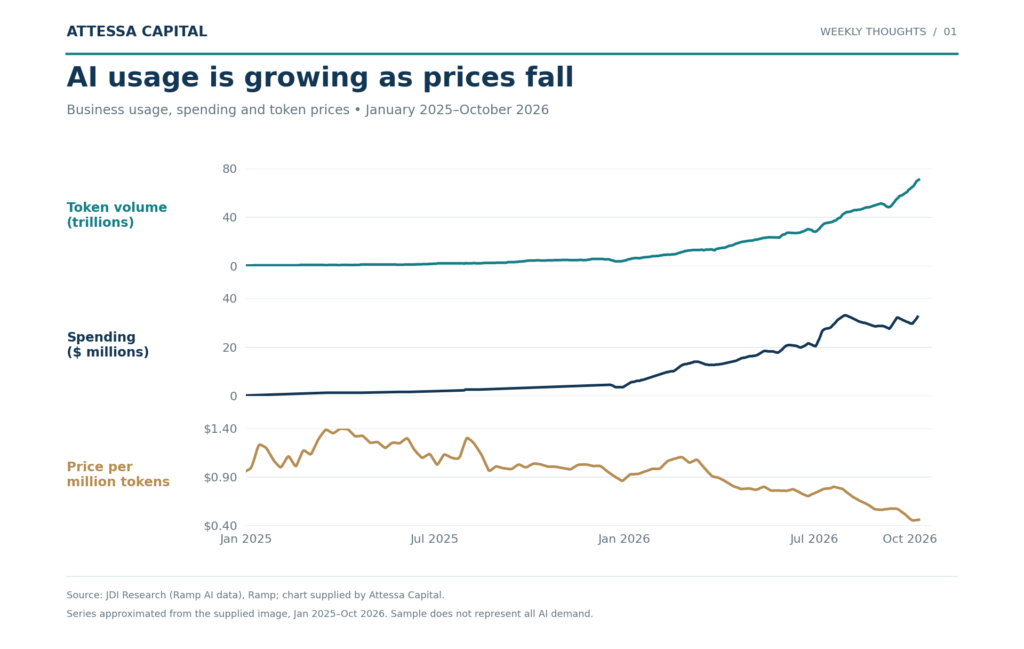
The first chart shows that AI usage has continued to expand even as the price of using the technology has declined. Tokens are the units used to measure the information AI systems process. In this sample of businesses using Ramp, rising token volumes have more than offset falling prices, allowing spending to grow.
Lower prices can make the technology economical for more tasks. That can encourage greater adoption and help explain why cheaper AI services do not necessarily mean a shrinking market.
The revenue figures provide another perspective. Exponential View estimates that revenue across the AI economy it tracks reached $140 billion over the twelve months through August, compared with $44 billion a year earlier. Its estimated annualized revenue run rate reached $229 billion. That second figure describes the recent pace of revenue, rather than the amount already earned over a full year.
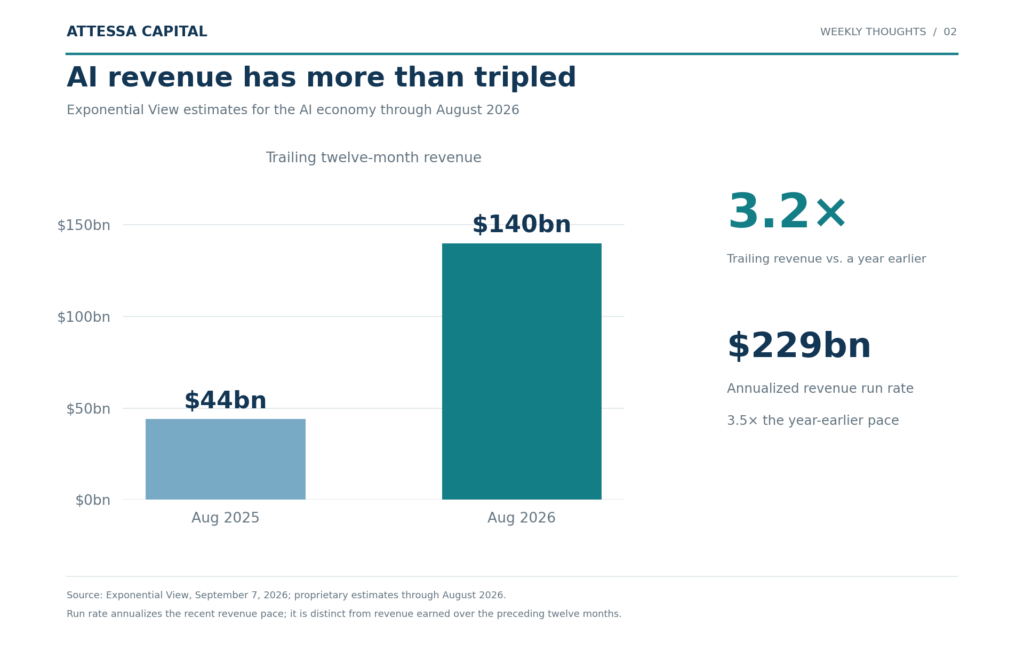
This is substantial commercial growth. However, revenue alone does not tell us whether infrastructure owners will earn an attractive return. Their results will also depend on construction costs, equipment replacement, competition, and the margins they retain.
There is also a broader benefit to consider. The next chart shows inflation-adjusted revenue per employee for S&P 500 companies rising sharply in recent years. Producing more revenue with each worker can help businesses absorb higher costs and support earnings growth.
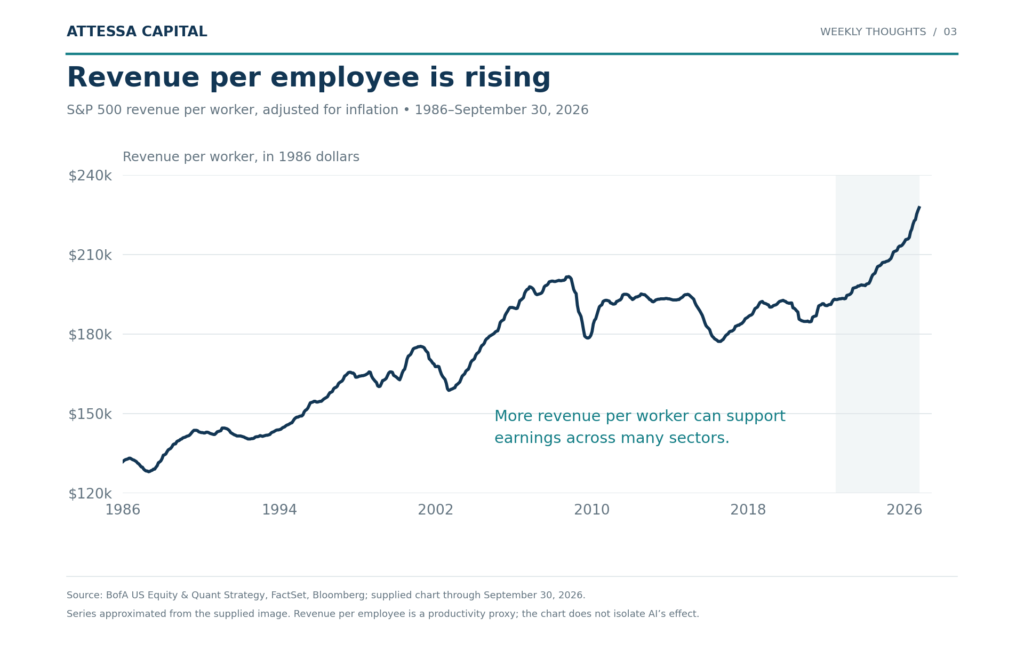
AI and automation may be contributing to that improvement, although this chart cannot isolate their effect. The potential benefits extend well beyond technology companies. Businesses throughout the economy may be able to use these tools to improve service, increase output, and reduce costs.
Meanwhile, technology valuations have adjusted. The chart below shows the sector’s forward price-to-earnings ratio at approximately 19.2, compared with a ten-year average of 23.0. Investors are paying a lower multiple for expected profits than the sector has typically commanded over that period.
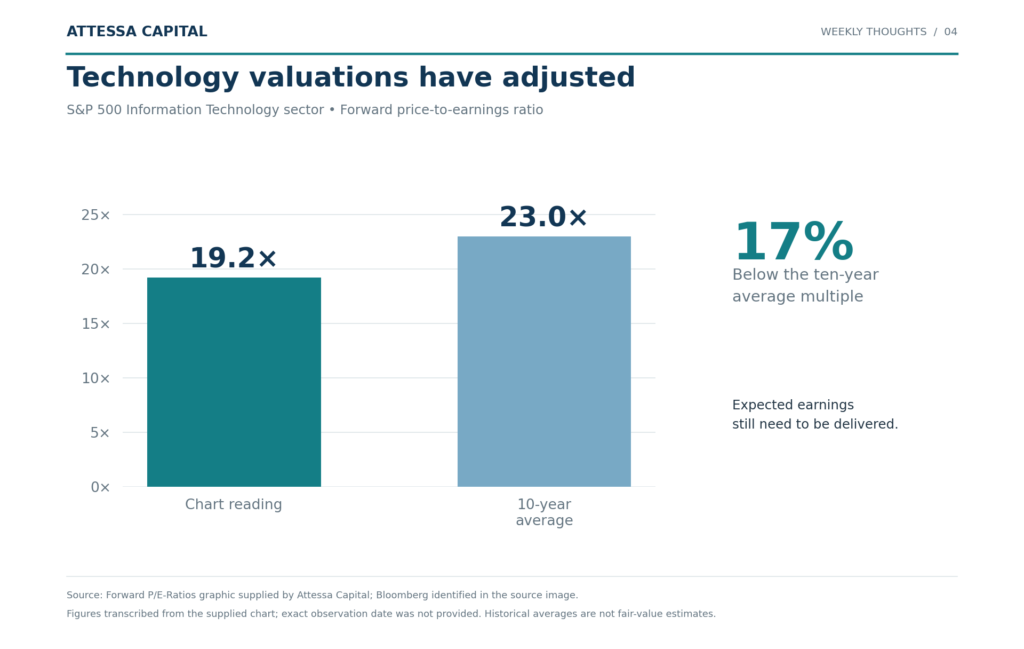
A lower multiple improves the starting point, but those earnings still need to be delivered. Forward valuations can become less attractive if profit estimates are revised down.
We continue to see reasons to maintain technology exposure within diversified portfolios. Customer usage and revenue are growing, business efficiency is improving, and valuations have become more reasonable. We will keep watching whether earnings and cash flow justify the capital being committed. There may be further volatility along the way, but the underlying data gives us reasons to remain constructive.