April 2025: Private Investments, Public Misconceptions

We continue to see a lot of misinformation about private investments so let’s try to separate fact from fiction. Last week an article was published in the Wall Street Journal that criticized private investments with a lot of misinformation. Coincidentally, I was giving a lecture at the Eller Business School at The University of Arizona on this topic at the same time the article came out.

Let’s discuss some of the most common misconceptions on private investments and provide clarity.

Common Misconception: Public Investments Have Performed Almost as Well as Private Investments

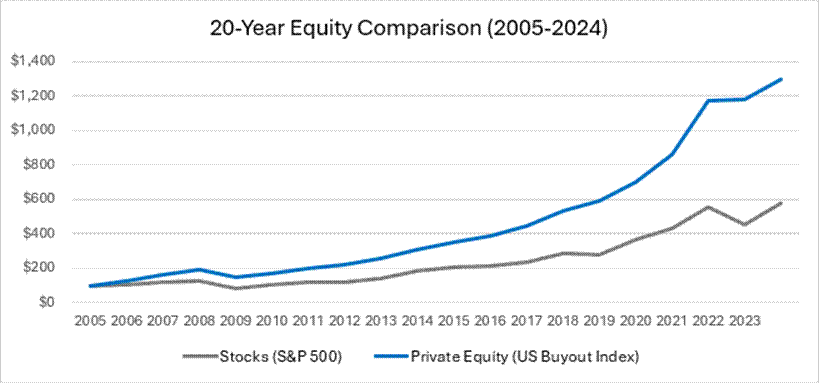
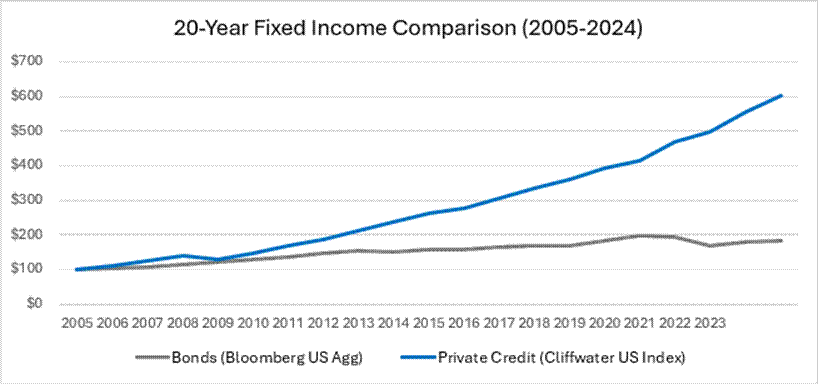
Private equity has averaged a 14.7% annual return net of fees and expenses the past 20 years compared to the S&P 500 index at 11.9%. Private credit has averaged a 9.5% annual return net of fees and expenses compared to the Bloomberg US Aggregate index at 3.1%. Combining these higher average returns with lower price volatility has a compounding effect further magnifying the actual return an investor earns.

The historic outperformance of private investments is not a guarantee they will continue to outperform their public counterparts. However, we believe outperformance of private investments will continue but the overall magnitude of that outperformance might be lower going forward than it has been in the past.  

Common Misconception: Private Investments are Higher Risk than Public Investments

There are lots of factors to consider when comparing the risk of an investment. A few that are most relevant when looking at private investments are:

  • Diversification: A concentrated private equity position in a single company like Space X is higher risk than a diversified Vanguard S&P 500 fund. However, some private equity funds (like the StepStone private equity fund) have over 3,000 individual companies with the top 5 largest companies representing less than 3% of the fund. These private equity funds are more diversified than a Vanguard S&P 500 fund with 500 companies and the top 5 representing 25% of the fund.
  • Valuation: Does the company solely rely on the manager’s calculation or estimate of value for reporting unrealized returns? Most private investments rely on auditor approval once a year which is a step in the right direction. However, most private investment funds available to individual investors today also conduct independent, third-party appraisals at regular intervals.
  • Fund Structure: Before the recent evolution of private investments, most private funds were truly private vehicles that avoided SEC oversight but still subject to some federal securities laws and state-level laws. Today, many private investment managers are blurring the lines by offering access to private investment holdings inside publicly registered vehicles with the same level of regulatory oversight as traditional public funds. The fund structure is an important consideration when evaluating the risk of a private investment.
  • Leverage: Some private funds use debt to magnify returns (or losses) and some don’t. Understanding how a strategy may employ leverage is important in evaluating risk.
  • Illiquidity: This can vary quite a bit among private investments even in the same category. For example, some private equity funds offer quarterly liquidity and some lock-up your funds for 10-15 years. When selecting private investments, we heavily consider a funds illiquidity and try to diversify our exposure to enhance liquidity options.

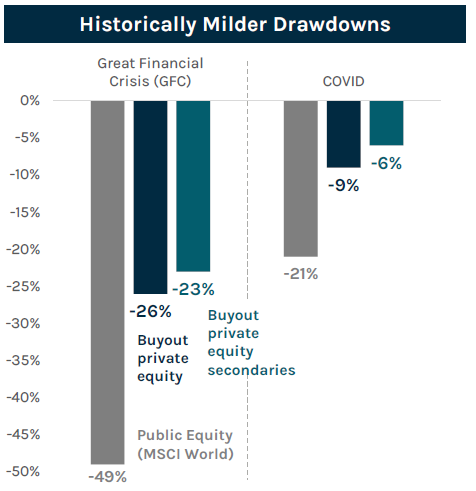
One of the best measures of risk, in our opinion, is how an investment performed during periods of extreme stress. As Warren Buffett once said, “Only when the tide goes out do you discover who’s been swimming naked.”

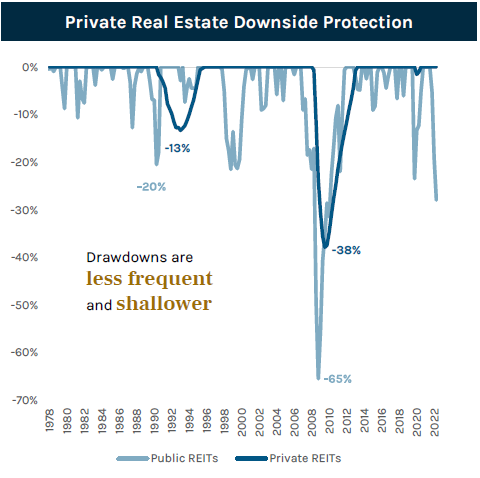
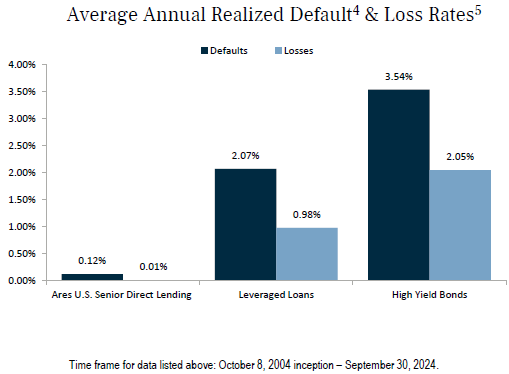
The recent COVID epidemic is one period to consider but may also not be the best indicator of true economic stress due to the quick economic recovery experienced after massive fiscal and monetary stimulus. The 2008-2009 was the most economically stressful period in recent memory. During this extreme period, private equity significantly outperformed public equity, private real estate significantly outperformed public REITs, and the more reputable private credit lenders avoided meaningful defaults. Painting public or private investments with broad stroke descriptions such as “more risky” or “less risky” is the wrong approach and several factors need to be carefully evaluated before making any conclusions on risk level.

Common Misconception: The Lower Volatility of Private Investments Hide True Volatility Risk

At the end of the day, publicly traded stocks are similar to private equity – ownership in a business, publicly traded bonds are similar to private credit – loans, and publicly traded REITs are similar to private real estate – owning property.

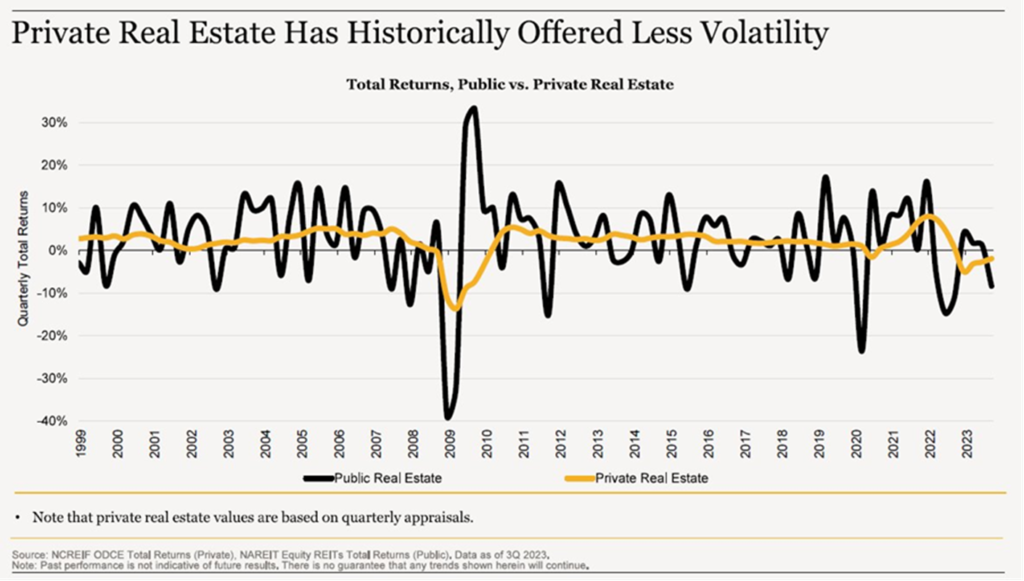
Publicly traded stocks, bonds, and REITs are constantly re-valued during market hours as investors agree on a price to buy and sell. Private investments are typically valued quarterly.

Naturally, an investment that is only valued quarterly will have lower price volatility than an investment valued every second of every trading day. Real estate investments are a good example since values are generally stable, yet publicly traded REITs are one of the highest volatility investment categories. Does the true value of a diversified real estate holding company really jump around that much?

Invitation Homes (INVH) is a public real estate company that owns over 5,000 residential homes across the US. In early 2020, the company’s value declined over 50% only to recover most of this value a few months later. The actual median sales price of homes sold across the US was starting to climb during this same time period. Did all 5,000 homes lose half of their value and then recover it a few months later?


The lower price volatility of private investments is an appealing characteristic for investors tired of the whiplash sometimes experienced in public markets. Volatility is just one form of risk and while private investments often provide investors with a smoother ride, there are many other risks you need to consider before making a private (or public) investment. Academics frequently debate whether public investment pricing or private investment pricing is more accurate. Private investment managers accuse public investments of “excess volatility” and public investment managers accuse private investments of “volatility laundering”. We see the merit in both sides of this argument and believe the truth is somewhere in the gray area in between.


Common Misconception: The Illiquidity of Private Investments Is Not Appropriate for Individual Investors


Private investments are less liquid than public investments and this illiquidity is a risk. All investments have risk and the return you receive for holding that investment generally corresponds to the risk you accept.


We call the higher return you receive from this illiquidity the “illiquidity risk premium”.


The Yale Endowment has an infinite time horizon and can support allocating over 75% to alternative investments because they can accept this illiquidity (and receive the higher return).


Our clients don’t live forever, unfortunately, but do you really need 100% of your retirement portfolio available for withdrawal every day? Most research on this topic actually concludes that the average investor fails to properly capture this increased return by not accepting enough illiquidity (see a recent CFA article here).


The actual amount of additional return you receive from this illiquidity varies across time, market cycles, and investments. Here is Bloomberg’s attempt to calculate the illiquidity risk premium in private equity:

Private investment managers recognize that locking up funds for 10+ years may not be appropriate for some individual investors so many have created funds that offer quarterly redemptions.


Remember that these private investment funds mostly hold long-term investments so they must install safety guards to protect against a forced fire sale scenario so these quarterly redemptions can be restricted in certain environments.


It is important to fully understand the illiquid nature of the underlying fund assets, the redemption provisions allowed by the fund, and how these dynamics may interact in various environments. The illiquidity of private investments needs to be carefully evaluated in the context of an investor’s possible future cash needs and potential opportunity costs but, in general, most investors should allocate more to less liquid investments and better capture this illiquidity risk premium.


Common Misconception: All Advisors Can Access the Same Private Investments


The private investment landscape is evolving rapidly allowing more access for individual investors and we are confident this trend will continue. However, the access to these various private investment strategies varies widely by advisor and platform.


The large wirehouse firms (Merrill Lynch, Morgan Stanley, Wells Fargo, UBS, etc.) only allow a fraction of the private investment offerings onto their platforms. Often, they require those private investment managers to pay a significant fee to be on the platform (“pay to play”).


Many private investment vehicles offer the same private investment fund in different share classes allowing the advisor and wirehouse to collect fees in different ways. As a fee-only advisor, we never earn a sales commission for any investments we make.


We were researching a private real estate fund last year that we decided not to invest in but it highlights the importance of how you choose to access private investments. 


We could invest in the fund through the institutional channel at a 14% lower cost and lower ongoing expenses than the exact same fund offered on Morgan Stanley’s platform resulting in an estimated 42% better return (using the fund’s base case return projections over 5 years).


Also, many of the private investment managers completely avoid the wirehouse firms and choose to partner with only a select number of advisors. Being an independent RIA with private investment expertise, we can access a broader menu of private investments than most advisors.


We’ve covered a lot of ground yet have only scratched the surface on private investing. This new evolution of private investments is an exciting time allowing individual investors access through advisors to a private investment world that was previous restricted to large institutions and the ultra-high net worth investor.


However, private investments can be complex and most advisors do not have adequate expertise to analyze these investments. We do agree with the WSJ author’s concern over this movement, “There’s a dark side: encouraging financial advisers and investors to believe that anyone can easily mix private funds with public assets.”


Disclaimer: It should be noted that this article may have been modified, changed, or amended since its original dissemination and, as such, the material contained in this article is for general informational purposes only. The views expressed are, or were, the views of BGK Capital, LLC and are subject to change at any time based on market and other conditions, without notice. This is not an offer or solicitation for the purchase or sale of any security and should not be construed as such. References to specific securities and issuers are for illustrative purposes only and are not intended to be, and should not be interpreted as, recommendations to purchase or sell such securities. Nothing contained in this material is intended to constitute legal, tax, securities, financial or investment advice, nor an opinion regarding the appropriateness of any investment. The information contained in this material should not be acted upon without obtaining advice from a licensed professional.

Furthermore, while the material is based on information that is considered to be reliable, BGK Capital, LLC makes this information available on an “as is” basis without a duty to update, and makes no warranties, express or implied, regarding the accuracy of the information contained herein. BGK Capital, LLC is not responsible for any errors or omissions or for results obtained from the use of this information.

(520) 600-3064

© 2021 All Rights Reserved