This week, investors received an important update on the artificial intelligence investment boom. Alphabet reported outstanding second-quarter operating results. Total revenue increased 24%, Google Cloud revenue increased 82%, and the company’s operating margin expanded from 32% to 34%.
Yet, the stock fell nearly 7% the following day.
Why would investors punish a company for reporting accelerating revenue, expanding margins and earnings that were much better than expected?
The answer is that the market has started asking a different question. Until recently, investors wanted evidence that demand for AI products was real. That question has largely been answered. Now investors want to know whether the enormous investment required to build AI infrastructure will produce attractive long-term returns.
AI Demand Is Not the Problem
Alphabet’s results provide compelling evidence that companies and consumers are using AI services. Google Cloud revenue rose from $13.6 billion in the second quarter of 2025 to $24.8 billion in the second quarter of 2026. Cloud operating income increased from $2.8 billion to $8.8 billion over the same period.
In other words, Alphabet’s AI and cloud investments are already producing substantial commercial growth. This is not a situation in which companies are building data centers without customers.
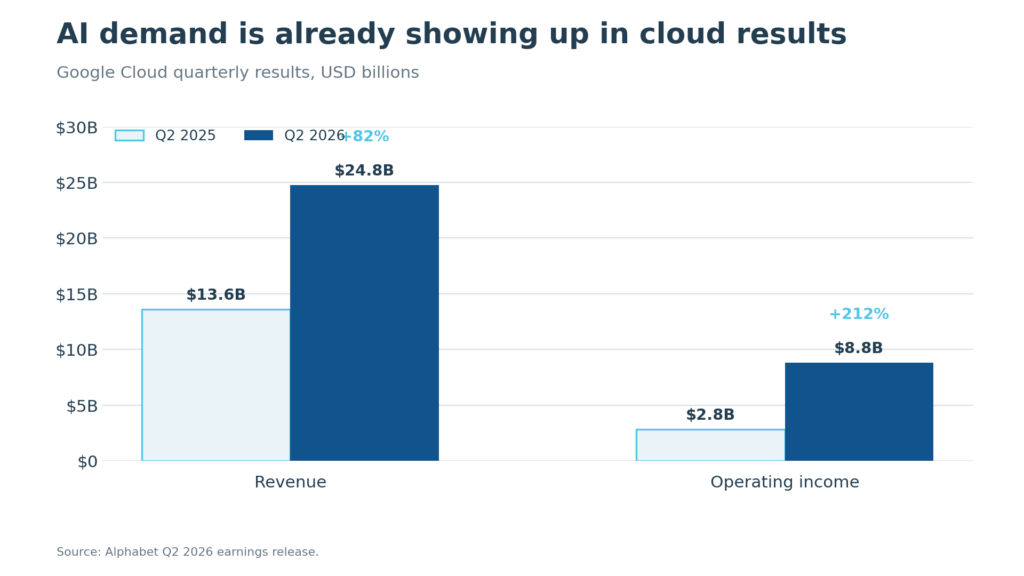
However, strong demand does not automatically guarantee attractive investment returns. The answer depends on how much capital must be committed, how quickly the equipment becomes obsolete, how intensely providers compete and how much customers are ultimately willing to pay.
The Cost of Competing Is Rising
Alphabet spent $44.9 billion on capital expenditures during the second quarter. That was nearly twice the $24.0 billion it spent just three quarters earlier. At the same time, quarterly free cash flow declined from approximately $24.5 billion to negative $5.9 billion.
One negative quarter does not put Alphabet in financial distress. The company still produced more than $53 billion of free cash flow over the last twelve months and maintains a substantial pool of cash and marketable securities. But the direction of the figures is important: the cash required to build AI infrastructure is currently growing faster than the cash being generated by the business.
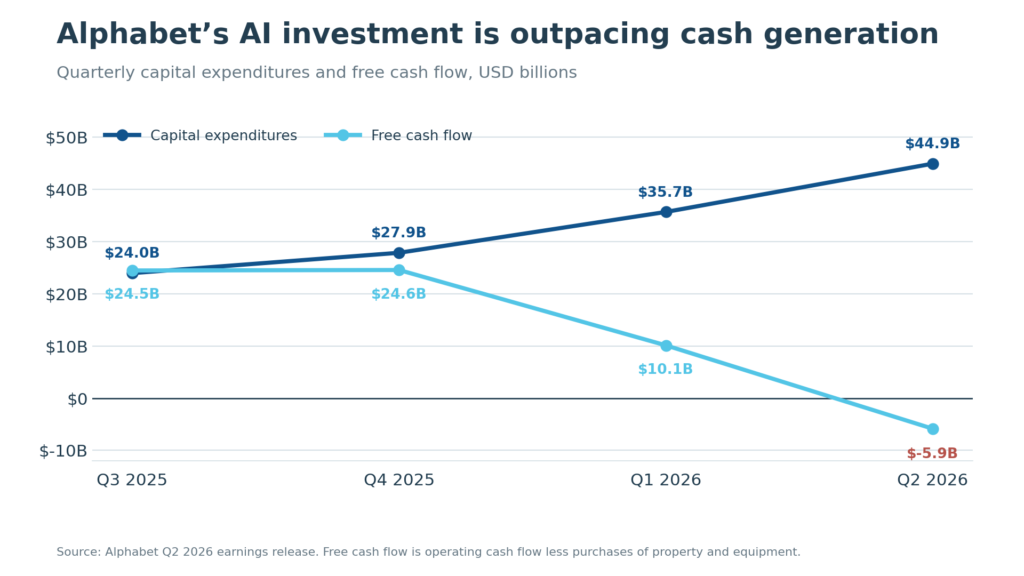
Alphabet also raised nearly $50 billion of equity and issued approximately $20 billion of senior debt during the quarter. Big Technology companies, once prized for their asset-light business models and enormous cash generation, are increasingly turning to outside capital to finance their AI ambitions.
This does not necessarily mean that the investments are unwise. It means the burden of proof is rising.
From Software Economics to Infrastructure Economics
Traditional software businesses are attractive because one additional customer can often be served at very little incremental cost. AI infrastructure is different. Data centers require land, buildings, semiconductors, networking equipment, cooling systems and enormous amounts of electricity. Much of that equipment must be replaced or upgraded every few years.
The major technology companies also face a competitive problem. Even if the near-term return on a new data center is uncertain, choosing not to build may allow a competitor to take customers and establish a technological lead. Consequently, companies may continue spending simply to preserve their existing market positions.
This dynamic has appeared in previous infrastructure cycles. The fiber-optic investment boom helped create the modern internet and produced enormous benefits for consumers and businesses. But not every company that financed or built that infrastructure earned a satisfactory return.
A technology can transform the economy while some investors still pay too much for its development.
The Builders May Not Capture All the Benefits
The AI ecosystem can be divided into three broad groups.
Infrastructure suppliers sell semiconductors, networking equipment, power systems, cooling equipment and construction services. These companies benefit immediately from rising capital expenditures, although their results will eventually depend on whether the building cycle continues.
Infrastructure owners build and operate the cloud platforms. They can earn excellent returns if capacity stays tight, utilization remains high and customers are willing to pay premium prices. Their risk is that expanding capacity and competition eventually turn computing power into a more interchangeable commodity.
AI users may ultimately capture a large portion of the economic value. Businesses that use AI to increase productivity, reduce costs or create new products can benefit without financing the data centers themselves.
These groups have different financial characteristics. Simply labeling a company an “AI investment” tells us very little about the price being paid, the durability of its competitive position or its likely return on capital.
What We Are Watching
Over the next several quarters, we will be watching whether AI-related revenue can keep pace with capital spending. High data-center utilization, stable cloud margins and a recovery in free cash flow would suggest that the current construction cycle is producing attractive returns.
Conversely, we would become more cautious if capital-spending forecasts continue rising while revenue growth slows, depreciation begins compressing margins, or companies become increasingly dependent on debt and equity issuance. Falling prices for computing capacity would be good for AI users but could make the economics more difficult for infrastructure owners.
The Bottom Line
We continue to believe that artificial intelligence will be an important driver of economic growth and corporate earnings. Alphabet’s results reinforce that view: demand is strong, revenue is accelerating and real profits are being generated.
However, the investment story is becoming more complicated. The first stage of the AI boom rewarded nearly every company associated with the theme. The next stage is likely to reward companies that can convert AI spending into durable free cash flow and attractive returns on invested capital.
That distinction argues for diversification and valuation discipline, not for abandoning AI exposure. The technology may be changing the world, but investors must still ask the same timeless question: What return are we receiving for the capital being put at risk?