This week we want to talk about earnings.
That may sound less exciting than the other stories investors have been following recently. Over the past several weeks, markets have had plenty to digest: geopolitical risk, oil-price volatility, interest rates, the Federal Reserve, artificial intelligence, and questions about whether the economy is slowing.
Those issues all matter. But as earnings season begins, the market’s focus is shifting back to something more basic: are companies actually making enough money to justify stock prices?
That question matters because earnings expectations have been moving higher, not lower.
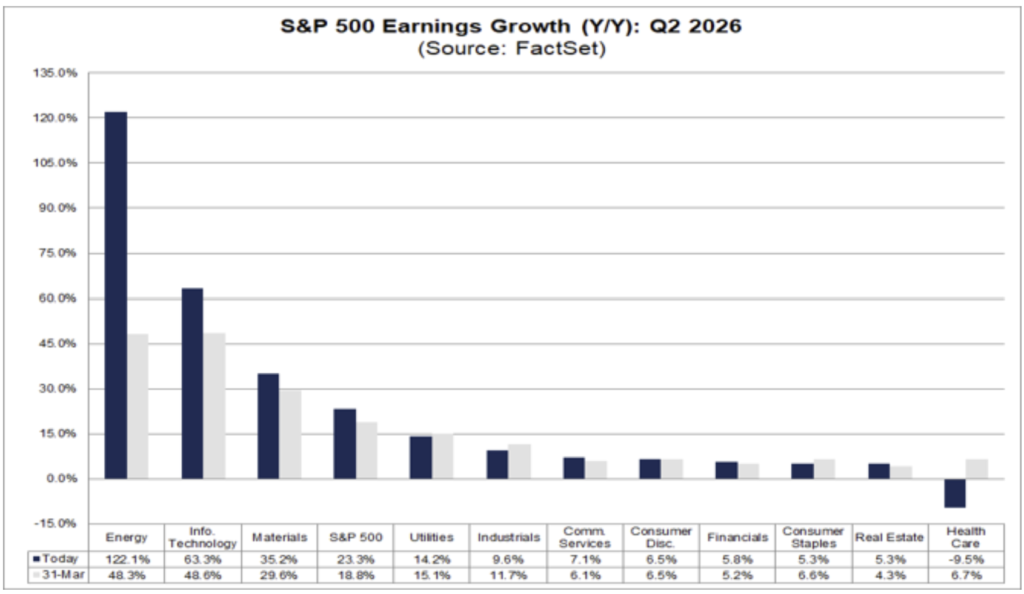
According to FactSet, S&P 500 companies are expected to report 23.3% year-over-year earnings growth for the second quarter. That is up from an expected growth rate of 18.8% at the start of the quarter. If achieved, this would mark the second consecutive quarter of earnings growth above 20% and the seventh consecutive quarter of double-digit earnings growth.
Revenue expectations have also improved. FactSet expects S&P 500 revenue growth of 12.2% for the quarter, up from 9.5% at the beginning of the quarter. If achieved, that would be the highest revenue growth rate since the second quarter of 2022.
That is good news.
It suggests corporate America may be in better shape than many investors feared a few months ago. It also helps explain why the market has been able to look past a number of potential risks. When earnings are growing, revenues are rising, and companies are still guiding positively, investors tend to be more willing to tolerate short-term noise.
But there is another side to the story. Higher expectations raise the bar.
In a typical quarter, analysts usually reduce earnings estimates as reporting season approaches. Companies often guide cautiously, analysts lower estimates, and then many companies are able to “beat” those lowered expectations.
This quarter has been different. FactSet reported that the S&P 500 bottom-up EPS estimate for Q2 increased by 3.4% during the quarter, rising from $78.84 on March 31 to $81.54 on June 30. For context, over the past five years, earnings estimates have typically declined by an average of 2.0% during the quarter. Over the past ten years, they have declined by an average of 2.7%.
In other words, analysts did not spend the quarter lowering the hurdle. They raised it.
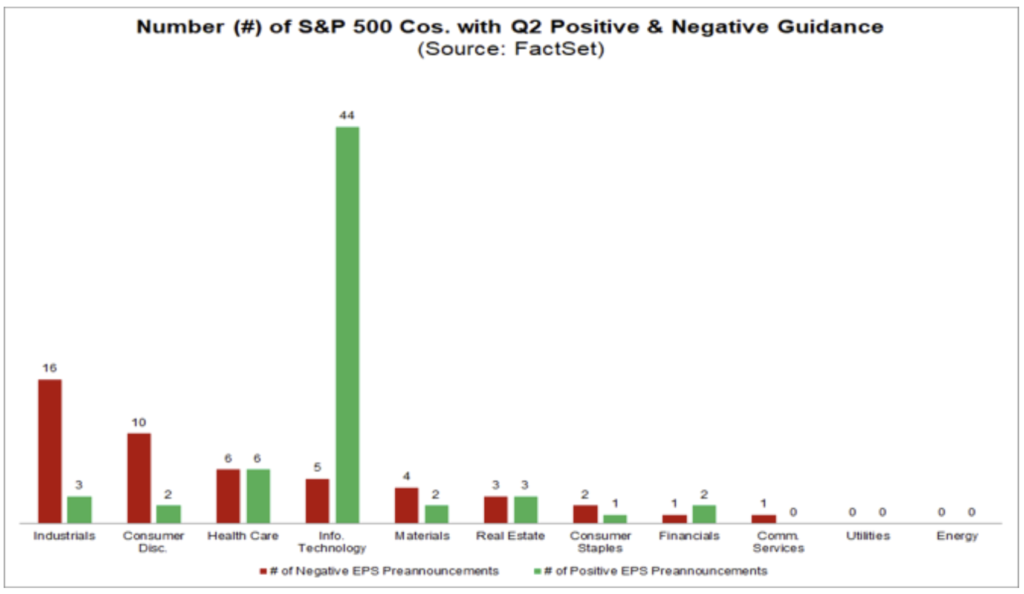
Companies have also been more optimistic than usual. FactSet reported that 111 S&P 500 companies issued EPS guidance for Q2. Of those, 63 issued positive guidance and 48 issued negative guidance. Positive guidance represented 57% of total guidance, well above both the 5-year and 10-year averages of 41%.
That is encouraging, but it also creates a more difficult setup for stocks. When expectations are low, companies can often clear them with modestly better results. When expectations have already been revised higher, “good” results may not be good enough. Investors may want strong earnings, healthy margins, and confident guidance.
The optimism is also not evenly distributed.
FactSet noted that much of the upward revision in Q2 earnings expectations has been concentrated in Energy and Information Technology. Energy had the largest increase in Q2 EPS estimates during the quarter, rising 61.5%. Information Technology had the second-largest increase, rising 8.7%.
Technology is especially important. FactSet reported separately that 44 S&P 500 technology companies issued positive EPS guidance for Q2, the highest number since FactSet began tracking the data in 2006. That supports the idea that demand tied to artificial intelligence, semiconductors, software, and related infrastructure remains real.
But it also means the technology sector has less room for disappointment.
This is an important distinction. A strong long-term theme can still become expensive in the short term. AI may continue to be a major driver of economic growth and corporate investment, but that does not mean every AI-related stock will always justify its valuation. Great businesses can still disappoint if expectations have moved too far ahead of results.
The same is true for the broader market.
Strong earnings growth is a positive backdrop. But markets do not move on earnings alone. They move on the relationship between earnings, expectations, and price. If investors already expect a lot of good news, companies may need to deliver even better news to keep stocks moving higher.
That is why this earnings season matters.
It is not simply a report card on the last quarter. It is a test of whether recent market optimism is supported by actual business performance. Investors will be watching revenue growth, profit margins, forward guidance, capital spending plans, credit quality, and whether companies are seeing any meaningful slowdown from consumers or businesses.
It is healthy for markets to refocus on fundamentals. Headlines can move prices over days or weeks, but earnings, cash flow, margins, and balance sheets matter more over time. The market has been resilient because the earnings backdrop has improved. Now companies need to prove that the improvement is real.
Markets can rally on optimism for a while. But eventually, optimism needs to be supported by earnings. This quarter, the market is about to find out whether it is.