This week we want to discuss interest rates and, more specifically, why a Federal Reserve pause does not necessarily mean that all interest rates are about to decline.
At its July meeting, the Federal Reserve left the federal funds target range unchanged at 3.50%–3.75%. Since then, several economic reports have given the Fed more reason to wait. Payroll employment declined by 23,000 in July, prior months were revised lower, consumer inflation moderated, and July retail sales fell 0.6%.
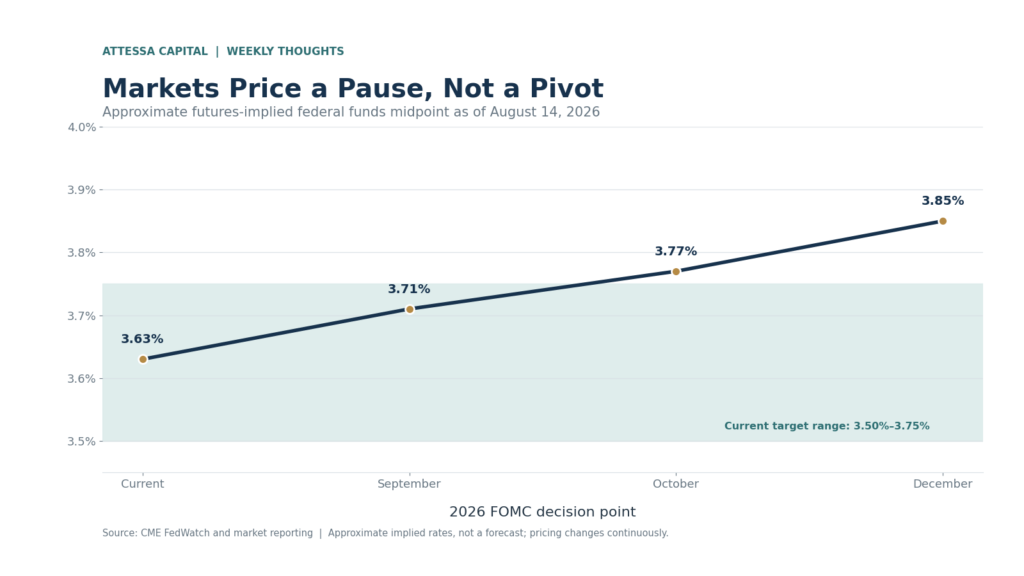
Those reports reduced expectations for an immediate interest-rate increase. Fed funds futures now favor another pause at the September meeting.
However, a pause is not the same as a pivot to lower rates. Inflation remains above the Fed’s 2% objective, core PCE inflation was 3.3% in June, and consumer expectations for inflation remain elevated. Three members of the Federal Open Market Committee voted to raise rates in July. Even after this week’s softer data, markets were still pricing approximately 22 basis points of additional tightening by December—nearly one quarter-point increase.
The Fed Does Not Control the Entire Yield Curve
It is easy to speak about “interest rates” as if they were a single number. They are not.
The Federal Reserve directly controls an overnight interest rate. Treasury bills and other short-term instruments are heavily influenced by the current federal funds rate and expectations for the next few Fed meetings.
Long-term rates reflect a much broader set of risks. A person lending money to the government for twenty or thirty years must consider future inflation, economic growth, federal borrowing, Treasury supply, and the possibility that the investment will need to be sold before maturity. Investors generally require additional compensation for accepting that uncertainty.
That distinction explains what happened this week. Expectations for a September Fed hike declined, and two-year Treasury yields fell. At the same time, the Treasury sold 30-year bonds at a yield of 5.216%, the highest auction yield since 2001. The short end was responding to softer economic data. The long end was responding to inflation, fiscal, and duration risk.
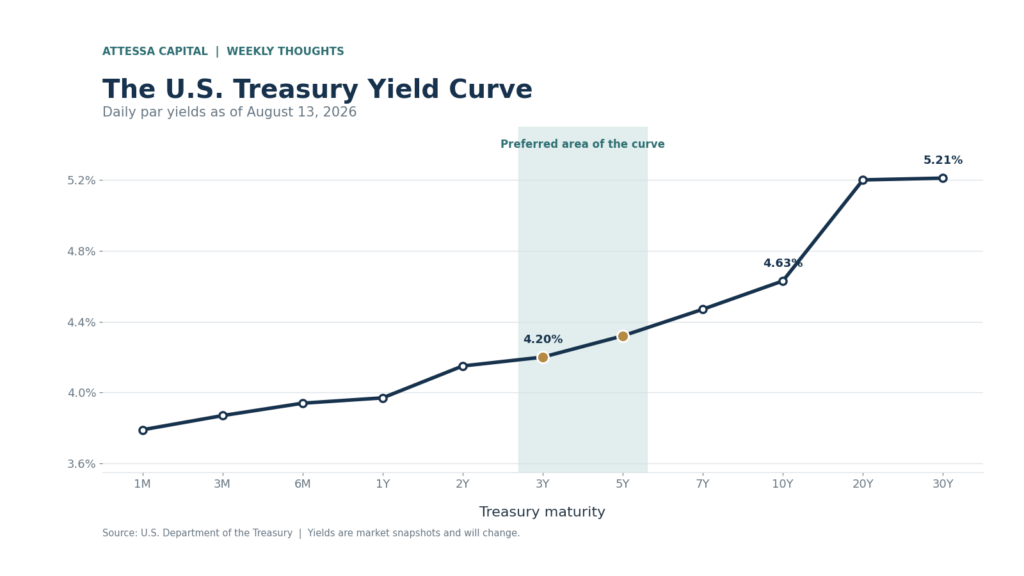
As of August 13, the 3-year Treasury yielded 4.20%, the 10-year yielded 4.63%, and the 30-year yielded 5.21%.
The 3-year Treasury therefore offered approximately 81% of the yield available on a 30-year Treasury. Moving from three years to ten years added only 0.43 percentage point of yield. Moving all the way to thirty years added 1.01 percentage points.
The additional income is real. But so is the additional interest-rate sensitivity.
We currently believe a public bond portfolio duration of approximately three to four years offers the most attractive balance between income, flexibility, and interest-rate risk.
Duration is a measure of how sensitive a bond or bond portfolio is to changes in market interest rates. It is related to maturity, but it is not the same thing. A portfolio can own securities with several different maturities while maintaining an overall duration target of three to four years.
First, yields are attractive. Investors can earn meaningful income without committing capital for ten, twenty, or thirty years.
Second, the yield curve offers relatively little additional compensation for moving substantially longer. The 10-year Treasury offers only 0.43 percentage point more yield than the 3-year, despite carrying far greater sensitivity to changing rates.
Third, a three-to-four-year duration still provides some potential appreciation if the economy weakens and interest rates eventually decline. Cash does not provide that same benefit because short-term instruments mature quickly and must then be reinvested at the new, potentially lower rate.
Finally, this positioning does not require us to make a precise forecast about the Fed’s next decision. If inflation remains elevated and the Fed raises rates again, the portfolio has less interest-rate exposure than a long-duration strategy. If growth weakens and rates decline, it has more upside and more income locked in than cash.
Balancing Two Different Risks
Investors at the short end of the curve face reinvestment risk. Cash and Treasury bills currently provide attractive income, but that income can disappear quickly once the Fed begins reducing rates.
Investors at the long end face duration risk. Long bonds may perform very well if inflation collapses and interest rates decline substantially. But they can also experience meaningful price declines if inflation remains sticky, federal borrowing increases, or investors demand greater compensation for holding long-term debt.
We believe the middle of the curve provides a better balance today. A three-to-four-year duration allows investors to lock in current income for a reasonable period, retain flexibility as bonds mature, and avoid making an oversized bet on the direction of long-term rates.
What We Are Watching
Our view is not permanent. We would reconsider it if long-term yields rose enough to provide substantially better compensation for duration risk, or if the economy weakened sufficiently to make a significant decline in long-term rates more likely.
In the near term, the Fed will receive another core PCE inflation report, another employment report, and August CPI before its September meeting. Those releases may change the probability of a September increase. They are less likely to eliminate the longer-term uncertainty surrounding inflation and federal borrowing.
That is why we do not think the entire fixed-income portfolio should depend on correctly predicting the next Fed decision.
The Bottom Line
The Federal Reserve may pause in September. That does not mean long-term interest rates must decline, and it does not mean investors are being adequately compensated to accept substantially more duration risk.
Today, the three-to-four-year portion of the market offers much of the available yield while avoiding much of the sensitivity associated with longer bonds. It also locks in income for longer than cash and provides some potential appreciation if rates eventually fall.
We cannot know the exact path of interest rates. We can, however, position portfolios so that success does not depend on getting that path exactly right.